


Next-Generation Wagyu Nexus
A research hub that builds a production system for Wagyu raised on grass, together with the people and the community to sustain it. Using advanced science, we work to restore the original balance between people, animals and the environment, and to create a community where no one goes hungry, the environment is not destroyed, and people can live with pride.
-
Representative
Kiyohiro Houkin
Hokkaido University President

-
Project Leader (PL)
Takafumi Gotoh
Hokkaido University Professor

-
Deputy PL (Industry)
Hirofumi Iwai
GB Sangyoka Sekkei Representative Director

-
Deputy PL (Industry)
Masaki Takada
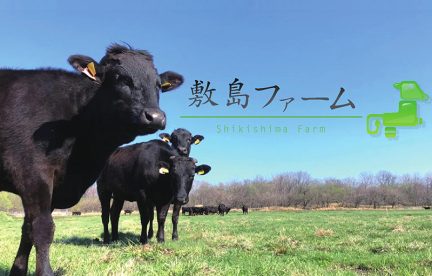
Shikishima Farm Representative Director

-
Deputy PL (Local Government)
Takuji Kikuchi
Shiraoi Town, Hokkaido Section Chief


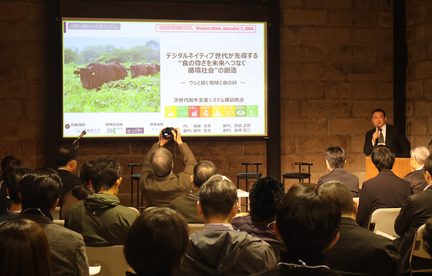
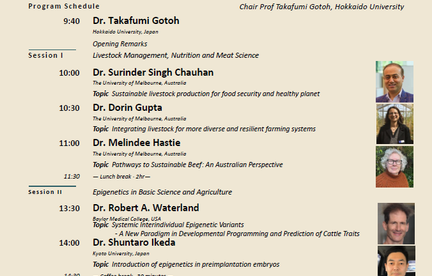
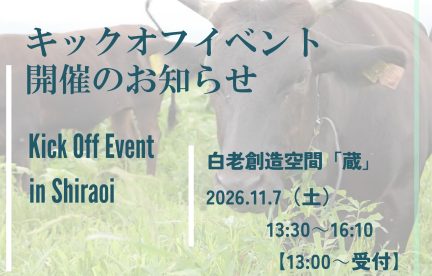
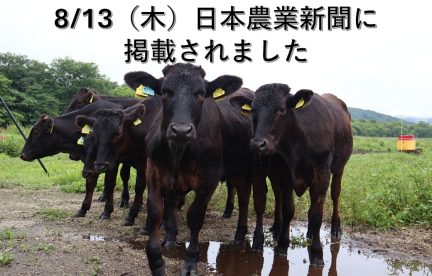
Where livestock farming stands, and where we are headed
Grain feed required per head of Wagyu6tself-sufficiency13%and the balance−80,000yen

“Chicken does well, pork breaks even, and cattle are in real trouble.”
This has been said on farms for decades. Raising a single head of Wagyu results in a loss of about 80,000 yen, and the number of farmers continues to fall (MAFF, Statistical Survey on Farm Management and Economy, 2024). One major cause is feed. A single head of Wagyu requires roughly 6 metric tons of grain feed, and only 13% of that is produced in Japan. Farm economics are therefore at the mercy of world affairs and exchange rates.
There is more. Cattle are herbivores by nature, and feeding them large amounts of grain increases internal disorders — placing Japan further outside global standards for animal welfare.
The alchemy of making meat — protein — from nothing but grass and water

Japan has a great deal of abandoned farmland. When grazing and hay-making decline, grasslands are lost, and with them the plants, animals and microorganisms that live there.
Cattle are ruminants: they can turn grass into protein. While the self-sufficiency rate for grain feed is 13%, for grass (roughage) it is 78%. If unused land can be turned into pasture, we see a path not only to conserving biodiversity but to breaking away from import dependence. Grazing is also a technology for putting land to use.
By 2050, global demand for livestock products is projected to rise 1.8-fold, and the “protein crisis” is becoming a real prospect. The ability of cattle to convert grass — which people cannot eat — into meat will only grow in significance.
Defying the assumption that grass-fed means lean
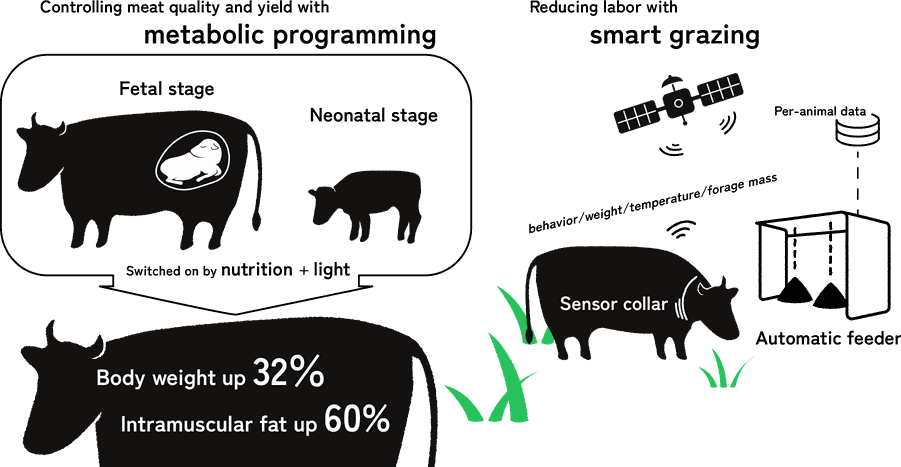
Cattle raised on grass tend toward lean meat. On its own, that does not meet a market that expects the qualities of Wagyu, and it is rated poorly under the current grading system. This is where we use metabolic programming: shaping the animal’s constitution through nutrition and light immediately after birth. In trials during the feasibility phase, simply changing nutrition during the suckling period increased body weight by 25-32% and intramuscular fat by more than 60%.
We are also developing smart grazing — watching over cattle through IoT so that their condition can be monitored and managed from a single smartphone. The aim is to reduce the burden of grazing management and open livestock farming to a younger generation.
Civic pride, spreading out from Shiraoi

What we are working toward is a community where the people who live there can say: “this is our pride.”
The setting is Shiraoi, a town in Hokkaido. In 1954 it staked its future on introducing Japanese Black cattle, and built a source of pride in “Shiraoi Beef.” Livestock accounts for roughly 98% of the town’s agricultural output, and 47% of its residents are aged 65 or over. What this one town faces is exactly what Japanese livestock farming faces as a whole.
Good technology does not take root without people to carry it, and without a community that takes it on as its own. Alongside developing the technology, we are developing the next generation and building places where they can come together. What we confirm here, we carry to other parts of Hokkaido — and on to the rest of Japan.
“A community free from hunger, abundant, where people can go on living” — that is what our civic pride is built on.
Research Target 1
Rethinking livestock farming
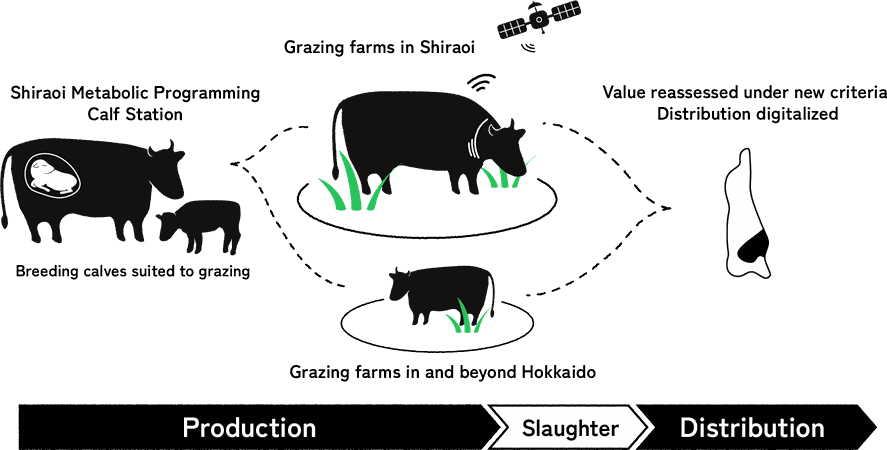
Producing the yield and the quality we intend, even on grass — that is the condition for grass-fed Wagyu to work as a business. We are establishing the techniques for it through metabolic programming, which shapes the animal’s metabolism from the fetal and neonatal stages, and smart grazing, which tracks cattle and pasture using satellite positioning and sensors.
We also question the very assumption that grazing must be good for the environment. We measure greenhouse gases, water quality, soil, and animal health, and verify our own work against a combined “taste, environment and health” index.
And because grass-fed Wagyu is difficult to value under the current grading system, we are building a new way of assessing it — adding environmental impact and animal health to AI image analysis of the carcass — so that its value can be assessed fairly, from production through to distribution.
R&D Theme 1
-

Leader
Prof. Susumu Muroya
Kagoshima University
-

Prof. Shinobu Yasuo
Kyushu University
-

Assoc. Prof. Yutaka Suzuki
Hokkaido University
R&D Theme 2
-

Leader
Prof. Masato Yayota
Gifu University
-

Project Assoc. Prof. Akira Kodaka
Keio University
R&D Theme 3
-

Leader
Prof. Keigo Kuchida
Obihiro University of Agriculture and Veterinary Medicine
-

Prof. Kenichiro Shimada
Obihiro University of Agriculture and Veterinary Medicine
-

Assist. Prof. Saki Shimamoto
Kagoshima University
R&D Theme 4
-

Leader
Assoc. Prof. Yoshitaka Uchida
Hokkaido University
-

Lect. Yenling Cho
Hokkaido University
Research Target 2
Rethinking learning

Technology does not spread without people to carry it. The number of young farmers keeps falling, and changing how cattle are raised is not enough on its own — this is what became clear over two years of the feasibility phase.
People’s values and behavior are shaped by their environment and their education. This hub therefore places education itself among its research themes, and is building a program grounded in systems thinking and design thinking — one that develops people able to take a broad view of management, the environment and the community, not only the techniques of livestock farming.
To bring an end to “agricultural science flourishes while farming dies,” we put the classroom on farms and ranches as well, developing people on site through repeated cycles of design, experiment, analysis and redesign.
R&D Theme 5
-

Leader
Prof. Naohiko Kohtake
Keio University
-

Prof. Kenji Hirao
Fukuoka University of Education
Research Target 3
Rethinking community

In livestock farming as it has been, producers and consumers have remained apart, and local residents have been left outside the conversation. As long as it remains someone else’s business to the people who live there, a new way of raising cattle will not spread.
Building on what became clear during the feasibility phase, we are working to create what we call a “Boarding Place” — a hub of knowledge and daily life where residents, educational institutions, private companies, and researchers work together, and where the practice of a circular society meets learning.
We design a space where nature, livestock and people live together, and extend its effects into tourism, entrepreneurship and education. Residents and producers will draft a brand charter together, and brand the region through Shiraoi Grass-fed Wagyu. Verifying that change scientifically as we go, we connect it to a Grass-fed Wagyu Village that brings production, education, learning and business support together in one place.
R&D Theme 6
-

Leader
Assoc. Prof. Rie Nomura
Hokkaido University
R&D Theme 7
-

Leader
Assoc. Prof. Yoshiharu Shimizuike
Hokkaido University
Participating Institutions
-

-

-

-

-

-

-

-
Managing Institution

-
Managing Institution

-
Managing Institution

-

-

-

-

-

-

-

-

-

-

-

-

-
